For this assignment, I am interested in exploring the intersection between indigenous educational institutions in North America and their relationship to open educational resources, open access to educational opportunity and open degree programs. At a number of Universities in northern Canada- Cape Breton University, Nova Scotia, Canada, their goal is to Engage with The Truth and Reconciliation Commission’s Call to Support Healing, Dialogue, and Learning for First Nations.
The course, co-taught by Stephen Augustine and Ashlee Cunsolo, was offered both as a for-credit course and as a free, open educational offering...
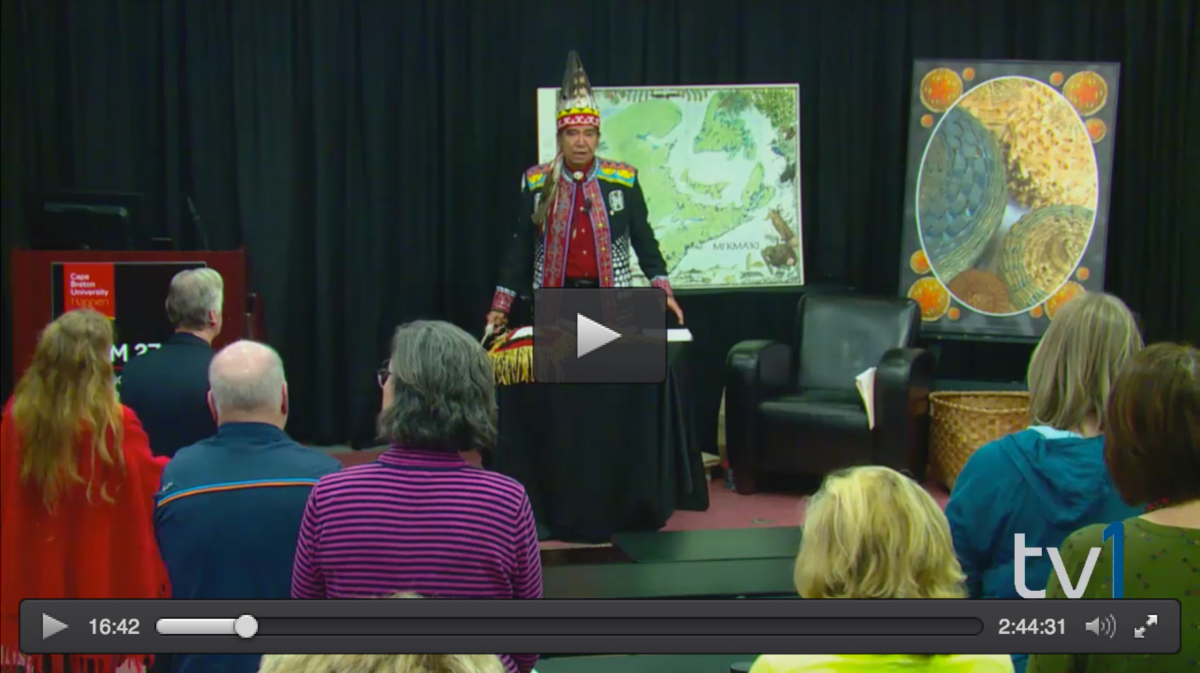
The course was designed in such a way as to share Mi’kmaq oral history and traditional knowledge, as presented by the knowledge keepers of Mi’kma’ki. The content and knowledge was shared through a series of lectures, presentations, and dialogues with Indigenous persons in the community. Each class began with a traditional sweetgrass or sage smudging ceremony and ended with drumming and singing. This spiritually set the tone and ambiance for the rest of the evening and the entire course.
Figure 2: The classroom setting: screenshot from Week 3 – Oral History, Traditions and Ways of Knowing
This work has been released into the public domain by its author, the Truth and Reconciliation Commission of Canada. This applies worldwide.
In some countries this may not be legally possible; if so: the Truth and Reconciliation Commission of Canada grants anyone the right to use this work for any purpose, without any conditions, unless such conditions are required by law.
Much of the political and social energy involved in Canadian Open Education and Open Textbooks Canada is associated with reconciliation with First Nations. For more information about this this topic, you can find resources here at this website and the following contacts:
Open education is growing across Canada. Canada OER, a national working group comprised of OER projects and interested institutions from provinces and territories across the country, meet bimonthly to share information and promote open education. For more information about this group, email opentext@bccampus.caFor open education information specific to your province, please contact one of the following groups. For general information related to Canada, see list of federal organizations at the bottom.
I have translated this section into French:
Initiatives d'éducation ouverte du Canada
L'éducation ouverte se développe partout au Canada. Canada OER, un groupe de travail national composé de projets REL et d'institutions intéressées des provinces et territoires à travers le pays, se réunit tous les deux mois pour partager de l'information et promouvoir l'éducation ouverte. Pour plus d'informations sur ce groupe, envoyez un courriel à opentext@bccampus.ca
Pour obtenir des informations sur l'éducation ouverte spécifiques à votre province, veuillez contacter l'un des groupes suivants. Pour des informations générales sur le Canada, voir la liste des organisations fédérales en bas.
CONTACTPROVINCIAL Alberta Alberta OER Email: albertaoer@googlegroups.comManitoba Campus Manitoba Carley McDougall, Special Projects Coordinator (mcdougallc@campusmanitoba.ca)
========== In doing this assignment I did have to change my initial licensing choice, because my original was Share Alike
Attribution-ShareAlike CC BY-SA and that was unnecessary.
This blog is published on Blogger, and according to Google, I (the author) own the copyright. But of course it is not that simple, because if you look for and find the details you get to this statement from Google:
When you upload or otherwise submit content to our Services, you give Google (and those we work with) a worldwide license to use, host, store, reproduce, modify, create derivative works (such as those resulting from translations, adaptations or other changes we make so that your content works better with our Services), communicate, publish, publicly perform, publicly display and distribute such content. The rights you grant in this license are for the limited purpose of operating, promoting, and improving our Services, and to develop new ones. This license continues even if you stop using our Services (for example, for a business listing you have added to Google Maps). Some Services may offer you ways to access and remove content that has been provided to that Service. Also, in some of our Services, there are terms or settings that narrow the scope of our use of the content submitted in those Services. Make sure you have the necessary rights to grant us this license for any content that you submit to our Services.
So if you wanted to assert theAttribution-NonCommercial-NoDerivs
CC BY-NC-ND to your blog entry, you have already agreed to something more-or-less the opposite.
The most restrictive licensed element of this blog is Share Alike, so it is not quite the case that the entry could be considered to comply with a free cultural works approved license. In that this applies to... works or expressions which can be freely studied, applied, copied and/or modified, by anyone, for any purpose.
This exercise is a challenging demonstration of how much analytical and policy work one needs to do to be fully conscientious about applying proper licensing when composing a work from composited sources. Even with my best effort and careful attention, there were a number of times when the licensing or attribution of a source could not be definitively determined, and it was far less work to choose a different item from a clearer source.



 Attribution-ShareAlike CC BY-SA and that was unnecessary.
 Attribution-NonCommercial-NoDerivs

No comments:
Post a Comment