Friday, May 29, 2020

Draft Research Question:

This is a new post to catch up with my current LiDA101 course. I will be putting in course content and my research proposal here.


=====

Draft Research Question:

Can a correlative relationship be established (in the US, but this could be other specific countries) and supported with evidence concerning the relationship between digital literacy practices and successful improvement of socioeconomic opportunity and educational gaps? 

I have chosen this topic because digital literacy is foundational to the social justice of access to, and creation of knowledge in the context of civil and human rights.

The pursuit of this question is primary to the mission of education and academic research. 


Attribution-ShareAlike
CC BY-SA


Tuesday, May 19, 2020

Open vs Commercial Textbook Comparison

Open vs Commercial Textbook Comparison


Dimension    Open textbook

Title                           Guide to Ancient Aegean Art
Publisher                    Smarthistory
Supplier                    Open Textbook Library UMN.edu 
Cost                          Free
Duration of access    Unlimited
Quality                     Harvard Ph.D candidate main author, but good
Advantages                Free, quickly accessed by all students
Disadvantages           Difficult to find academic reviews

Dimension    Commercial textbook (Rental or Purchase)

Title                          Introduction to Aegean Art,  by Philip P. Betancourt
Publisher                   Institute for Aegean Prehistory Press
Supplier                   Chegg.com
Cost                          Rental $USD 24 for 4 months or $36 direct purchase
Duration of access    16 weeks
Quality                     Outstanding, author is world authority, 35+ years in field
Advantages               Authoritative work, definitive scholarly research on topic
Disadvantages           There is a fee, the work is Copyrighted, limited printing or access to buy


Attribution-ShareAlike
CC BY-SA

Outputs – 4R learning challenge

Outputs – 4R learning challenge
for OERu LiDA103 May 2020


For this assignment, I am interested in exploring the intersection between indigenous educational institutions in North America and their relationship to open educational resources, open access to educational opportunity and open degree programs. At a number of Universities in northern Canada-  Cape Breton University, Nova Scotia, Canada, their goal is to Engage with The Truth and Reconciliation Commission’s Call to Support Healing, Dialogue, and Learning for First Nations.


The course, co-taught by Stephen Augustine and Ashlee Cunsolo, was offered both as a for-credit course and as a free, open educational offering...

The course was designed in such a way as to share Mi’kmaq oral history and traditional knowledge, as presented by the knowledge keepers of Mi’kma’ki. The content and knowledge was shared through a series of lectures, presentations, and dialogues with Indigenous persons in the community. Each class began with a traditional sweetgrass or sage smudging ceremony and ended with drumming and singing. This spiritually set the tone and ambiance for the rest of the evening and the entire course.
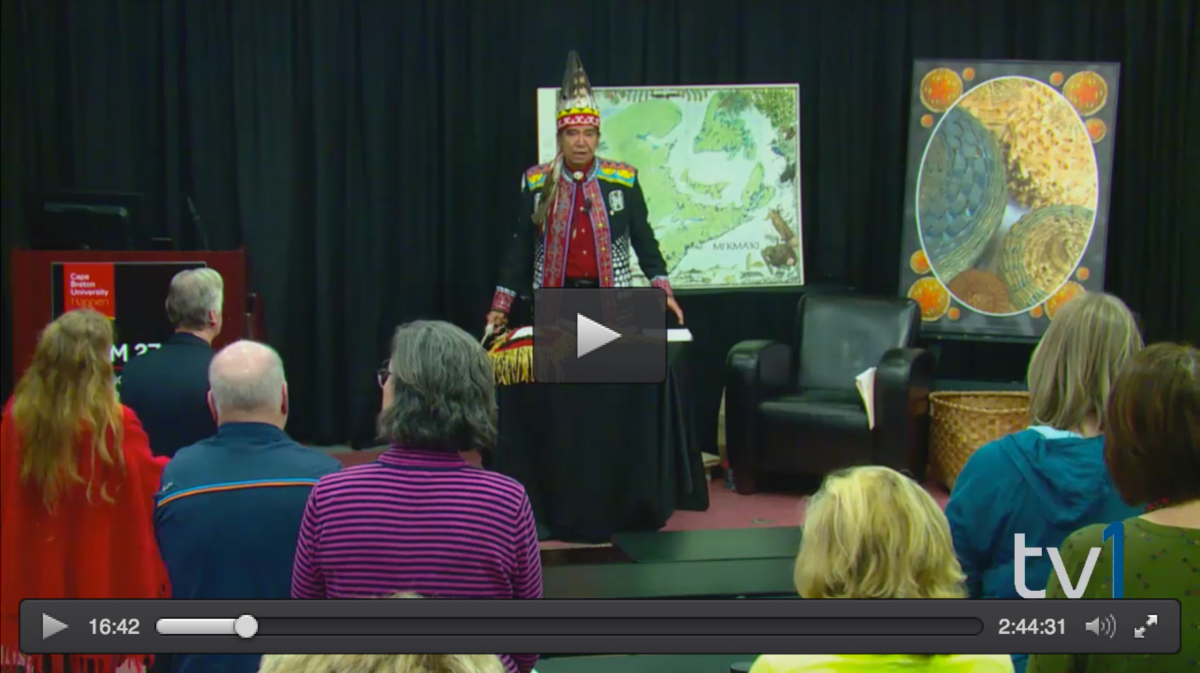
Screenshot from televised course: Learning from the Knowledge Keepers of Mi'kma'ki
Together with a colleague, Ashlee Cunsolo, Stephen launched an open, online, and free-access course called “Learning from the Knowledge Keepers of Mi’kma’ki” (MIMK2701) in January 2016.


Figure 2: The classroom setting: screenshot from Week 3 – Oral History, Traditions and Ways of Knowing


Truth and Reconciliation Commission of Canada Logo

Public domainThis work has been released into the public domain by its author, the Truth and Reconciliation Commission of Canada. This applies worldwide.
In some countries this may not be legally possible; if so:
the Truth and Reconciliation Commission of Canada grants anyone the right to use this work for any purpose, without any conditions, unless such conditions are required by law.


My altered Truth and Reconciliation Commission of Canada Logo


Much of the political and social energy involved in Canadian Open Education and Open Textbooks Canada is associated with reconciliation with First Nations. For more information about this this topic, you can find resources here at this website and the following contacts:


Canada's Open Education Initiatives  
Creative Commons License


Open education is growing across Canada. Canada OER, a national working group comprised of OER projects and interested institutions from provinces and territories across the country, meet bimonthly to share information and promote open education. For more information about this group, email opentext@bccampus.ca
For open education information specific to your province, please contact one of the following groups. For general information related to Canada, see list of federal organizations at the bottom.

I have translated this section into French:
Initiatives d'éducation ouverte du Canada
L'éducation ouverte se développe partout au Canada. Canada OER, un groupe de travail national composé de projets REL et d'institutions intéressées des provinces et territoires à travers le pays, se réunit tous les deux mois pour partager de l'information et promouvoir l'éducation ouverte. Pour plus d'informations sur ce groupe, envoyez un courriel à opentext@bccampus.ca
Pour obtenir des informations sur l'éducation ouverte spécifiques à votre province, veuillez contacter l'un des groupes suivants. Pour des informations générales sur le Canada, voir la liste des organisations fédérales en bas. 


CONTACT
PROVINCIAL
Alberta
Alberta OER Email: albertaoer@googlegroups.com
Manitoba
Campus Manitoba Carley McDougall, Special Projects Coordinator (mcdougallc@campusmanitoba.ca)


==========


In doing this assignment I did have to change my initial licensing choice, because my original was Share Alike
 Attribution-ShareAlike CC BY-SA and that was unnecessary.

This blog is published on Blogger, and according to Google, I (the author) own the copyright. But of course it is not that simple, because if you look for and find the details you get to this statement from Google:
When you upload or otherwise submit content to our Services, you give Google (and those we work with) a worldwide license to use, host, store, reproduce, modify, create derivative works (such as those resulting from translations, adaptations or other changes we make so that your content works better with our Services), communicate, publish, publicly perform, publicly display and distribute such content. The rights you grant in this license are for the limited purpose of operating, promoting, and improving our Services, and to develop new ones. This license continues even if you stop using our Services (for example, for a business listing you have added to Google Maps). Some Services may offer you ways to access and remove content that has been provided to that Service. Also, in some of our Services, there are terms or settings that narrow the scope of our use of the content submitted in those Services. Make sure you have the necessary rights to grant us this license for any content that you submit to our Services.
So if you wanted to assert the  Attribution-NonCommercial-NoDerivs
CC BY-NC-ND
to your blog entry, you have already agreed to something more-or-less the opposite.
The most restrictive licensed element of this blog is Share Alike, so it is not quite the case that the entry could be considered to comply with a free cultural works approved license. In that this applies to... works or expressions which can be freely studied, applied, copied and/or modified, by anyone, for any purpose.


This exercise is a challenging demonstration of how much analytical and policy work one needs to do to be fully conscientious about applying proper licensing when composing a work from composited sources. Even with my best effort and careful attention, there were a number of times when the licensing or attribution of a source could not be definitively determined, and it was far less work to choose a different item from a clearer source. 


My licensing for this Blog entry: CC-BY

Friday, May 15, 2020

Copyright Scenario with MCQs for LiDA103

Scenario:

Students are members of the Student Writers Association at a United States University, and their student group has a popular public Blog "The Court Jester" that is published on a weekly basis. This week they are putting together a political action piece that is critical of the University administration's Policy toward personal gender pronoun usage.


  • The students have put together a blog posting that includes an edited video based upon an official University website news update containing a 30 minute video of the U. President making a statement about policy toward gender pronoun usage. The students copied and edited the video without asking for permission. The student video is a mash-up of clips of the president, funny animations that they made, and their own mocking sound effects and laughter. The students are poking fun at the U. President and policy with ridicule.
  • In the student Blog entry they include a link to My.Pronouns,org https://www.mypronouns.org/what-and-why/ and they liked a image from this site, so a student saved and put a copy of the photo on their Blog header for this post. Later on in the same post the students inserted another photo from mypronouns.org by inserting it as a link to the original photo and adding a photo credit.


Questions (This is a multiple choice question with (1) one correct answer)

(1) Choose the correct statement about how the students used the University President's video on their blog.

(a) The students are violating copyright ownership because people always need to get prior written permission from the University to use the President's video.
     [Incorrect] There are a number of cases in which you may fairly use copyrighted materials. In this case the video segments are used for political speech and making a parody of the original video.

(b) Even though the students used the copyrighted work by remixing a number of video segments, their intent was to make a parody of the original policy statement and to ridicule the President. The student's work is therefore transformational and has not violated copyright. 
     [Correct] When someone transforms the original video to create a new work of parody, and political speech, there are more liberal fair use exceptions to copyright. The student's use would likely be defendable if taken to court.

(c) The students are in violation of copyright because they are plagiarizing the President's video.
     [Incorrect] The use of plagiarizing is sometimes confused with Copyright ownership, but is in fact not as much a legal definition, as a moral one, whereby the intent is deceit to portray someone's ideas and expressions as your own without attribution.

(d) Because the President's video first appeared on a website, it is now on the internet and can be freely used and shared any way the student's want to.
     [Incorrect] simply because content is available on the internet through a web browser does not make it free and public domain. There are a number of protections under copyright and licensing that limit the use of materials.


(1) Choose the True statement about how the students used the images from mypronouns.com in their Blog.
    
(a) The students are free to copy and paste the images, because they are digital and from a website that is publicly available on the internet.
     [Incorrect] simply because content is in a digital format, or available on the internet through a web browser does not make it free and public domain. There are a number of protections under copyright and licensing that limit the use of materials. Copying of the image onto their own Blog site is still making a copy of something.

(b) The students can use the images on their Blog, because as students, the use is educational and is not generating any profit.
     [Incorrect] Because something is being used by students does not necessarily make it educational fair use, nor is making a profit or not the only determinant factor.

(c) The use of the image by embedding a link to the originally posted picture on the website and captioning a photo credit is acceptable use.
     [Correct] Because in this case, the image has not been copied to the student's Blog server, in the US, although controversial, this is generally not considered a direct violation of copyright. It is also good that the students attributed the source of the image to the photographer.

(d) All of the images used by the students on their blog violate copyright.
      [Incorrect] There are acceptable uses of web-based images that can be linked to websites and blogs. Care needs to be taken to examine the author's intent (i,e, CC BY-NC-SA) if they have used Creative Commons licensing, their copyright ownership or statements about linking and re-use on their website.


Attribution-ShareAlike
CC BY-SA


MnLC OER SIG

May 15 2020 18:15 Zulu for #LiDA103

Had a meeting with MnLC (Minnesota State Learning Commons) OER Special Interest Group where we discussed the LiDA103 course. At least two of us among our membership are currently participating in the course. My summary of my experiences and the other participant led to a number of discussion threads from the international perspective gained by participating in courses such as these, the weight and credibility of this type of learning, comparisons to the Creative Commons certification curriculum and emphasis of focus on higher education, instead of K-12.


Attribution-ShareAlike
CC BY-SA

Open Education, Commodification of knowledge, Gatekeepers to Acces

May 11 2020 11:45 Zulu for #LiDA103

I have been giving a lot of thought about the implications of openness with regard to knowledge objects, the commodification of intellect and artistic work and the definition of Open Educational Resources. It brings to mind that there is always such internal tension and a genuine dialectic between ownership, knowledge as power; ideas as the new assets that have replaced the products of material wealth gained from refining raw materials into manufactured goods.

What follows from this is a much broader social contract and inalienability of rights surrounding access to knowledge and the opportunity, power and wealth that flow from gaining and controlling these knowledge objects. It is thus the transmission of knowledge to power that is bound up in the conversion of knowledge objects into learning objects, and there my friends is the crux of the issue with OER.

Peter Angelos: Personal Learning Space by Peter Jason Angelos is licensed under CC BY-NC-SA 4.0CC iconby iconnc iconsa icon

Reflections on Steven Downs

May 6 2020 21:40 Zulu for #LiDA103

Just saw a quick video from Stephen Downs
Key Points: it's just not about the money...not simply about the content...it's about the sharing. Education is not a one-way street. 

Reflection: The transition from analog to digital media changes modalities of interaction, communication and sharing. This digital sharing is predicated upon a universally viable system of open licensing and attributions (such as Creative Commons).
 
https://wiki.creativecommons.org/wiki/Open_license

Does open matter for you personally?

May 6 2020 for #LiDA103

  • Does open matter for you personally? Share your reasons why open does or doesn’t matter for you.
  • What can we learn from the current state of affairs regarding access to scholarly knowledge? What advice do you have for the future of learning in a digital age?

Yes. open really matters. Maybe not every day to the most privileged, well represented learners, but the impact is profound for many of our students. Having been in higher education these past 20+ years, I have seen the loss of collegiality and rise of commodity when it comes to learning resources. This is not only being driven by corporate publishers, but also through cultural changes at colleges and universities that has shifted from free and open knowledge for all, to proprietary control of intellectual property.

Granted, everything has become punctuated acutely with COVID-19, but at my institutions over the past few decades, control of information as property and commodity has increased, and access to creative work, research and art has become more restricted, expensive and socially stratified. The future of learning in the digital age is a fluid and rapidly changing environment, where the economic and social models of the past can no longer sustain the current higher education model, and the old Western paradigm no longer adequately aligns with the majority of the world’s population of learners.


Attribution-ShareAlike
CC BY-SA


Wednesday, May 6, 2020

Open Education, Copyright, and Open Licensing in a Digital World

Peter Angelos: Personal Learning Space


Wolf Rock overview on Lake Superior in Minnesota USA


This is a space where I reflect upon my personal learning on a number of topics.

The first use of this blog is my participation in an OERu micro-course:Open education, copyright, and open licensing in a digital world (LiDA103). 

The OERu has partnered with the Commonwealth of Learning (COL) and the International Council for Open and Distance Education (ICDE)


Peter Angelos: Personal Learning Space by Peter Jason Angelos is licensed under CC BY-NC-SA 4.0CC iconby iconnc iconsa icon